
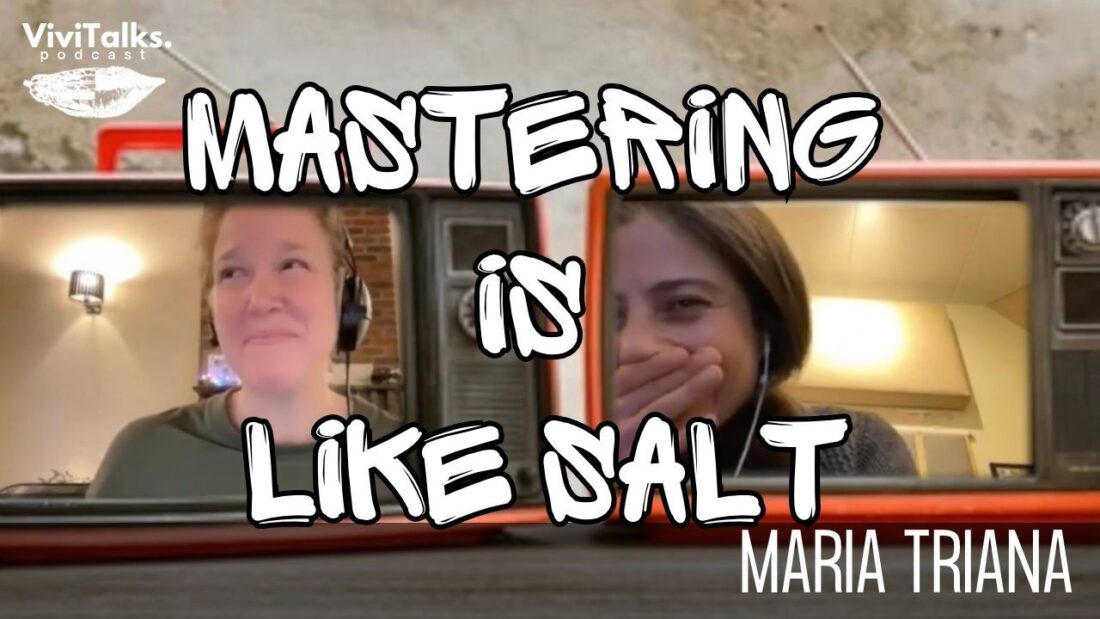
Maria Triana on Mastering, Women in Audio & the Typuhthâng Album
In this episode of ViviTalks I spoke with Maria Triana, the Colombian mastering engineer whose ears and artistry helped shape the final sound of Typuhthâng. Maria has lived in the U.S. for half of her life and is now based in the Netherlands, and from the first minutes of our conversation it was clear that she hears music in an almost cinematic way. She described the album as rich, challenging, and deeply rewarding, because every track lives in its own world. Her goal was simple and huge at the same time: bring out the best of it, and help it become one cohesive whole.
Maria is one of the 100 women on my album Typuhthâng. Maria mastered the whole album. The album supports female cacao farmers in Virunga National Park, Congo, and rainforest restoration. Every copy comes with chocolate.
A “picture book” approach to sound
Maria’s process began long before she touched a single frequency. Because she knew the story behind the album and how it developed, she could “see” it. She built a picture book in her head, imagining the environments, the soundscapes, birds, and textures, and then translated those images into choices about harmonics, tone, and space. Mastering, for her, is not just technical polish. It is adding color to an already vivid painting.
What a mastering engineer actually does
One of my favorite moments was Maria’s explanation of mastering for listeners who don’t live in the audio world. She compared making a record to cooking:
- Recording is choosing the best ingredients.
- Editing is chopping and prepping.
- Mixing is cooking and combining the flavors.
- Mastering is the final step, where she adds the condiments: the salt, pepper, or hint of lemon that can elevate everything.
It is a tiny shift that makes a huge difference. And it comes with responsibility, because at this stage you can enhance the magic or accidentally ruin it. Mastering is also the moment the work is finally “served” to the world.
Making an album feel like one journey
Maria emphasized something I care about deeply: albums as stories. In a single-driven industry, it is easy to forget the beauty of a full arc. She talked about how this record flows from one track to another, how each song carries an intention, and how even the space between tracks matters. That small breath between pieces gives the listener time to reset and enter the next chapter.
Creative freedom, and the fear that comes with it
I gave Maria a lot of freedom, and she was honest about what that feels like: inspiring, but also daunting. Mastering is the final step, and she described it as being handed someone’s baby and being trusted to deliver it safely. Even with a strong portfolio and years of experience, she still felt that familiar nervousness: “I hope she likes it.”
Texture, color, and a record that refuses to fit one box
When I asked what she loved most about the music, Maria kept returning to texture. She hears resonance and harmony as vibration and color, and she loved how the record moves through many worlds, from big choir moments to intimate details. She also pointed out that it is not mixed like a standard jazz, rock, or pop record. It is its own thing, made from many voices, recorded in many ways, then unified into one identity.
Women in audio, and why this matters
Maria described audio as deeply male-dominated, and women mastering engineers are still rare. That is part of what made this project powerful for her: a full record created by women, made possible by a coalition of talent, commitment, and love.
She said it plainly: we are not alone, and we do amazing work together.
What Maria is working on now
Since moving to the Netherlands, Maria works with independent artists and label projects, seeking more creative challenge and broader musical worlds. She also teaches at the Abbey Road Institute in Amsterdam. In her own education she had one female teacher to look up to. Now she gets to be that person for the next generation.
Hearing her reflect on watching an idea become real, from our first conversations to the final master, reminded me that finishing an album is not just completion. It is transformation.
More from Maria Triana
Follow Maria on Instagram at @mariatriana_mastering.
Watch the full ViviTalks episode with Maria Triana
Press play on the video at the top of this page to hear Maria Triana in her own words. You can also find this conversation, and every other ViviTalks episode, on YouTube.
More ViviTalks
ViviTalks is my interview series with the women behind Typuhthâng. Watch all episodes on YouTube or read more ViviTalks stories.