
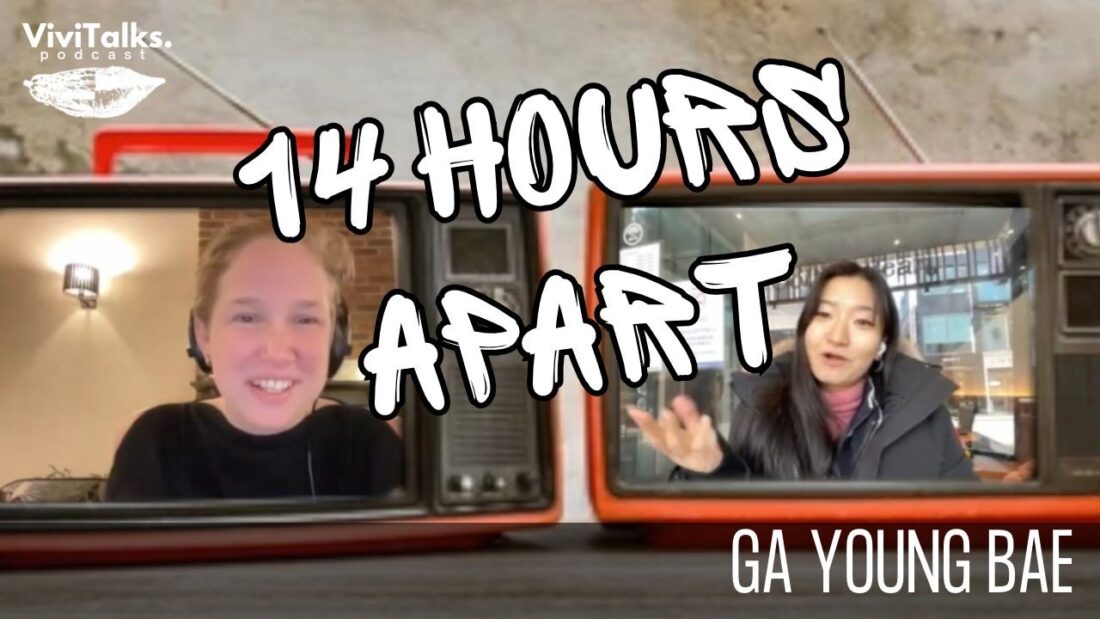
Ga Young Bae on Arranging Concept of Falling Across a 14-Hour Time Difference
In this episode of ViviTalks I spoke with Ga Young Bae, a South Korea-based pianist and arranger who brought a deeply personal touch to my song “Concept of Falling.” Ga Young arranged the piece and played piano on the recording, and our conversation became both a behind-the-scenes look at her creative process and a small reunion across time, geography, and memory.
Ga Young is one of the 100 women on my album Typuhthâng. Ga Young arranged “Concept of Falling” and plays piano on it. The album supports female cacao farmers in Virunga National Park, Congo, and rainforest restoration. Every copy comes with chocolate.
Why this song, and why now
Ga Young chose “Concept of Falling” for a reason that goes beyond arrangement details. She remembered the song from when we played together in Boston more than ten years ago, and the melody stayed with her because it is catchy, sweet, and full of feeling. It was a thread back to a shared time in our lives, and a way to reconnect through music after years and continents.
Arranging by imagining the feeling
Ga Young doesn’t rely on a rigid system or “special method.” She starts by imagining the emotional experience of the title itself: that uncomfortable moment of falling, losing footing, being pulled forward. She kept returning to the vibe, to the shape of the feeling, and to imagining my voice inside that world, so the arrangement would hold my musical personality and intention.
Singing through the piano
One detail I loved: she records herself playing and singing, even though she doesn’t consider herself a vocalist. It’s her usual way of working, a way to capture phrasing, breath, and emotional context. That recording gave me an immediate sense of where she was taking the song before any other instruments were added.
Choosing instruments: classical colors that “talk”
We leaned toward a classical palette for this piece. The combination that really shines is cello and clarinet, which Ga Young described as talking and singing, like two voices having a private conversation. She also loved how the ending became, with repeating and layered singing lines that keep turning over themselves and lifting higher.
A shared solo across 14 hours of time difference
Because we were on opposite sides of the world, we couldn’t improvise live in the same room. But we found a way to make it feel like we were. Ga Young created a solo and sent it to me, and I layered my voice on top, answering her phrasing until the moment the piano “takes off” into a higher, freer place.
She laughed about sending me a page of scribbles, her way of saying, “this is my solo, you can sing it.” Even across that distance, we were still responding to each other, just with a delay.
Zoom sessions and collaboration
Much of the process happened on Zoom, with me sharing my Logic Pro screen while we listened, edited, and adjusted together. The hardest part wasn’t the music. It was the time zone math: South Korea and New York are 14 hours apart. The music stayed easy, because the communication stayed open.
What Ga Young is creating now
Ga Young is working on her own trio project: a suite-like work about relationships between people, one long arc with eight songs inside it, for piano trio with bass and drums.
Women across borders, one heart
Ga Young spoke about what it meant to be part of a project made by women from all over the world. Different countries, different lives, but the same emotional core.
We can be one voice, even when we are far apart.
Ga Young Bae
This episode reminded me why I make music in the first place: not just to finish songs, but to connect people, across years, oceans, and time zones, through one shared language.
More from Ga Young Bae
Ga Young’s albums include Sepia Painting and Gugak and Jazz on Canvas Live Album.
Watch the full ViviTalks episode with Ga Young Bae
Press play on the video at the top of this page to hear Ga Young Bae in her own words. You can also find this conversation, and every other ViviTalks episode, on YouTube.
More ViviTalks
ViviTalks is my interview series with the women behind Typuhthâng. Watch all episodes on YouTube or read more ViviTalks stories.